 English
 Español
  Português
  русский
  Français
  日本語
日本語  Deutsch
  tiếng Việt
  Italiano
  Nederlands
  ภาษาไทย
  Polski
  한국어
한국어  Svenska
  magyar
  Malay
Malay  বাংলা ভাষার
  Dansk
Dansk  Suomi
Suomi  हिन्दी
  Pilipino
  Türkçe
  Gaeilge
  العربية
  Indonesia
  Norsk
Norsk  تمل
تمل  český
český  ελληνικά
  український
  Javanese
  فارسی
فارسی  தமிழ்
தமிழ்  తెలుగు
  नेपाली
  Burmese
  български
  ລາວ
ລາວ  Latine
  Қазақша
  Euskal
  Azərbaycan
  Slovenský jazyk
  Македонски
  Lietuvos
  Eesti Keel
  Română
  Slovenski
  मराठी
मराठी  Srpski језик


How to Choose the Right Steel Material Of The Mold?
When customizing a mold, selecting the right steel is an essential step. The choice of steel directly determines the mold's service life, processing difficulty, product quality stability, and overall cost, making it a core decision in mold design and production. A simple analogy: cooking different dishes requires different pots—stir-frying greens needs a wok, simmering soup calls for a clay pot, and searing steak works best with a thick-bottomed non-stick pan. The same logic applies to choosing mold steel: "There is no best steel, only the most suitable one."
Different steels vary significantly in hardness, wear resistance, corrosion resistance, polishability, and cost. Selection must be based on four key factors: product characteristics, production volume, plastic material, and molding process.
This article will guide you through the key aspects of selecting the right steel for injection molds.
A. Principles for Selecting Injection Mold Steel
Before choosing a steel, three core questions must be answered:
1.Determine Product Quality Requirements
Understand the product’s material, precision, surface quality, and whether it contains corrosive components. Different plastics require steels with varying levels of corrosion and wear resistance.
2.Consider Production Volume
Low-volume production may allow for lower-cost, lower-hardness steels. High-volume production demands highly wear-resistant, high-hardness steels to ensure the mold withstands hundreds of thousands of high-pressure cycles without deformation or wear.
3.Evaluate Mold Complexity
Complex molds are harder to process and require steels with good machinability and polishability. Excessively hard steels can reduce CNC processing efficiency, while impure steels may lead to pitting during polishing.
B. Common Injection Mold Steels & Their Properties
Injection mold steels can be categorized into four types based on performance: general-purpose, wear-resistant, corrosion-resistant, and high-precision polishable. Each type suits specific applications and must be matched accurately to requirements.
1.General-Purpose Steels
Examples: 718H, P20, 3Cr2Mo Moderate hardness, easy to process and polish, cost-effective. Suitable for ordinary plastics (PP/PE/ABS), molds with standard surface requirements, and simpler structures. Ideal for low-volume production.
2.Wear-Resistant Steels
Examples: H13, STAVAX ESR, 4Cr5MoSiV1,High hardness, excellent wear resistance, and heat resistance. Suitable for glass/mineral-filled plastics (e.g., PA66 + fiberglass, PBT + fiberglass) and molds requiring long life spans.
3.Corrosion-Resistant Steels
Examples: S136, STAVAX, 9Cr18Mo,Excellent corrosion resistance, easy to polish, and rust-resistant. Ideal for corrosive plastics (e.g., PVC) and molds for medical/food-grade products.
4.High-Precision Polishable Steels
Examples: NAK80, S136 ESR, 718H ESR,Extremely high purity, exceptional mirror polishability, and dimensional stability. Suitable for high-surface-quality products and molds that need to maintain a mirror finish long-term.
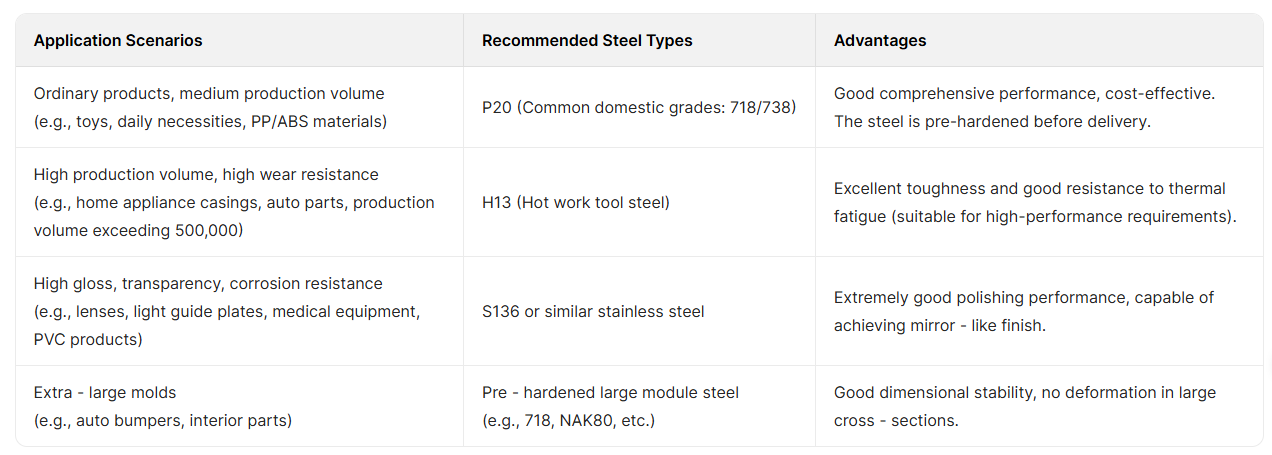
Choosing the right steel is not just about giving a mold its soul—it is a critical investment in your product’s quality, production efficiency, and long-term cost control.
If you’re looking to customize an injection mold, feel free to consult Hongmei Mold Factory. We provide clear multi-option comparisons and professional advice to help you make informed decisions. With the most reasonable investment, you will get the best-performing mold tailored to your needs. We look forward to collaborating closely with you, not only delivering a high-quality mold but also building a long-term partnership based on mutual benefit and trust.
Send Inquiry




X
We use cookies to offer you a better browsing experience, analyze site traffic and personalize content. By using this site, you agree to our use of cookies.
Privacy Policy